A Not-So-Typical Author’s Note
My sons were born three months early. They weighed one pound, thirteen ounces each.
The prognosis was terrifying
The doctors were honest: there was a good chance they wouldn’t make it. If they did, blindness or severe brain damage were very real possibilities.
My wife and I spent more than three months in the hospital waiting to find out which world we were going to live in.
We were blessed, some will say lucky. They made it. They came home on a cardiorespiratory monitor that tracked every breath. They came home with stage three retinopathy, the exact thing that causes the blindness the doctors had warned us about. It ultimately resolved. And they also came home with learning differences that would shape everything about how they grew up: how they learned, how they processed the world, how hard they had to work for things that other kids seemed to get easily. They faced challenges every single day, and what we learned as a family was that the only way through was to teach them to think differently. Not harder. Differently.
We were fortunate. With the help of family, our boys were able to attend a school specifically designed for kids with learning differences. The teachers there didn’t try to force my sons into a shape that didn’t fit. They found the shape that did. That made all the difference.
I know not every family has that option. I know that most don’t.
They figured out how to think their way through
Both my sons are twenty-three now. One is a paramedic and is applying to nursing school. The other became a licensed real estate agent right out of high school, passing his exam on the first try, but eventually realized it wasn’t the right path for him. He pivoted, went to college, earned his associate degree, and is waiting to hear back from the University of South Florida’s Muma College of Business, where he plans to major in Artificial Intelligence (AI) and Business Analytics.
I watched two kids who weren’t supposed to survive grow into two young men who figured out how to think their way through a world that wasn’t designed for them. I’m not sure I’ve ever been prouder of anything.
I was that kid, too
I know that world from the inside. I grew up in the sixties and seventies, and I was a poor student. The kid who didn’t get it, who didn’t fit the classroom. I still remember being in second grade and getting pulled out of class for remedial reading. The kid who walked down the hall while everyone else stayed behind.
That was the start of it. In fourth grade, when the class started cursive, my handwriting was so bad the teacher told me, “It’s a waste of time. Just color.” My mother went to the school and battled until they gave me a cursive workbook. The basic one, not the one everyone else got. But I learned it. They were already giving up on me at nine. She wasn’t. By eighth grade, I failed three of my four major subjects (English, social studies, and science) and barely scraped a C in math. They sent me to summer school and then passed me on to ninth grade anyway. That was the same year I failed the state-mandated Minimum Basic Skills test. While other kids moved forward, I was placed in a remedial basic skills course in tenth grade, ultimately fighting my way to pass the test in eleventh grade. It was during this period that my parents took me for testing; they never told me the full results, but I remember my mother crying and my father telling me something I already knew: I learned differently.
My parents did everything they could. But this was decades ago, and back then, most people simply didn’t understand these things the way we do now. There was no clear explanation for me, no plan, no special school. I just knew I was struggling, and I still didn’t know why. I only recently learned that there was another piece to that story. As an adult, I was diagnosed with autism and ADHD. Finding out didn’t change who I am; it simply gave me another way to understand how my mind had worked all along.
A kid like me today might have an IEP and a whole team behind it: teachers, specialists, parents at the same table. Back then, we were just put in the slow group.
Here’s the part nobody at school knew. Almost fifty years ago, in eighth grade (the same year I was failing three of my four subjects), I was fourteen and playing backgammon tournaments at night. Not kitchen-table games: sanctioned tournaments, with a director, a draw sheet, and master points on the line. The rules said you had to be sixteen to enter. Maybe eighteen; I honestly no longer remember. The director let it slide. I played against adults, and I won. Enough to earn a few master points of my own. I couldn’t tell you how many anymore, but somebody wrote them down.
Backgammon is nothing but odds, risk, and a board that changes with every roll. The kid who barely scraped a C in math was running live probability in his head against grown-ups. That year, the state tested me for minimum basic skills. The game rated me in master points. The thinking was never missing. School was just looking for it in a room where it didn’t show up.
Somewhere out there was a tournament director who bent a rule for a fourteen-year-old because he could see what the kid could do. This book is me returning the favor.
School never saw any of it. By the time I reached my senior year, they expected so little of me that when the graduation program was printed, my name wasn’t on the list. They called it a mistake. My family and I knew exactly what it was. I graduated anyway. I was accepted into college on probation. Conditional, a single shot, prove it or you’re done. They placed me in a mandatory basic skills class alongside my regular courses, and I knew the stakes. For the first time, the outcome was mine to decide. That’s when I finally figured out how I actually learned. And once I did, everything changed. I went on to earn an MBA and two doctorates. Not because the struggle disappeared, but because I finally had tools that fit the way my mind worked.
So when I tell you that thinking differently isn’t a defect, I’m not saying it from the outside. I’m saying it as the kid who failed three subjects in eighth grade, whose name they didn’t bother to print at graduation, and who walked into college on probation and decided he was going to make it anyway.
Who this book is for
This book is for the kid who has been told, directly or indirectly, that they think the wrong way.
The kid with learning differences. The kid on the spectrum. The kid who is quiet, intense, distracted, restless, stubborn, or “not school-smart.”
None of them needs to be fixed. This isn’t a book about any one diagnosis, and the chapters never mention autism or dyslexia by name. That’s not what it’s for. It teaches you how to use the shape your mind already has, whether that mind is racing ahead, still catching up, or just built differently. Whether the reason has a name or not, the tool is the same.
And it is just as much for the kid who is hungry to know more. The kid who asks questions nobody else is asking. The kid who finishes early and gets bored because the answer came too fast. The kid who is quietly certain there must be another way to solve the problem, and isn’t sure they’re allowed to say so.
And the truth is, this book is for every kid in between, too, which is most of them. Because this was never really about who is “struggling” and who is “gifted.” Every single kid has a way their mind works best, a niche where things finally click. Most of them are just never shown how to find it. That is what this book is for. Whatever kind of thinker someone is (quick or slow, restless or careful, ahead in one thing and behind in another), there is a way that fits, and learning how to find it changes everything.
And if school comes easily right now, these tools are needed too. Maybe most of all. Because one day, something won’t come easily. Some problems will be harder than anything you’ve faced yet, and nobody will hand out the answer. The kids who learn early how to think their way through hard things have a huge advantage when that day comes.
Why the format looks different
I shaped these pages with the same care I brought to the ideas. Larger type. Open lines. A left-aligned layout with room to breathe. A typeface chosen for readers who struggle, not the default nobody questions. None of it is decoration.
Reading is hard for some kids in a way that has nothing to do with how smart they are; the page itself gets in the way. I know because I watched it. One of my sons scored at the 1st percentile in visual memory (the bottom of the scale) and near the top in other areas. He didn’t get past it by trying harder at a page that fought him. He found the ways that fit how his mind works.
There’s art throughout, too, one never far from any page. Not decoration, and not a reward for finishing a hard paragraph. For a kid whose eyes need somewhere to land before the next stretch of words, a picture is a place to rest without leaving the page. The chapters are built the same way: short stretches with a marked break between them, so a reader who runs out of steam is never far from a place to stop and pick it up again. That’s part of the design, just like the type and the spacing.
This book is built so the page doesn’t fight the kid. And if this printed format still doesn’t fit the way the readers’ eyes and minds like to read, the digital edition gives you another way to adjust the page. The physical design is part of the promise of this book: the tools should fit the reader, not the other way around.
They didn’t fit the mold either
Some of the world’s most consequential thinkers did not fit the mold that school was built for.
Temple Grandin is autistic and thinks primarily in pictures. She used that way of thinking to design curved, calmer cattle-handling systems. Today, about half the cattle going through U.S. meat plants are handled in systems she designed.
Agatha Christie was, by her own account, a terrible speller. Writing was hard for her all her life, and her own family knew her, kindly, as “the slow one.” There was no name for it back then. She became the best-selling novelist of all time. The thing that fought her, putting words on paper, is the thing the whole world knows her for.
Steven Spielberg was rejected by USC’s film school. He built his own path instead: short films, college at California State University, Long Beach, and a lucky break. Universal signed him to a television contract after seeing his work, and he left college to pursue his directing career. Decades later, long after Jaws and E.T. and Jurassic Park, he went back and finished his degree anyway, just because he’d told his own kids it mattered.
Albert Einstein. You’ve probably heard he failed math. He didn’t. That story is a myth. He was an excellent student, especially in math and physics. He’d taught himself geometry and calculus years ahead of his class. What he couldn’t stand was how school taught it: memorize, don’t question, sit still. At fifteen, he left his school in Munich before finishing and later completed his secondary education at a school in Aarau, Switzerland, that let him question everything.
The point is not to become any of them. The point is simpler, and bigger: thinking differently is not a defect. It is a tool. One that anyone can learn to use to ask better questions, solve harder problems, and build something that matters.
Hand them the right tools
Not everyone finds their shape on their own. For years in the corporate world, I watched brilliant ideas die in conference rooms. Not because they were bad ideas, but because the people who had them had never been taught how to speak up, test them, or refine them out loud. The best thinkers often stayed quiet. And the loudest voices won.
This book is about giving kids the tools to avoid that trap: to ask better questions, share half-formed ideas without fear, treat being wrong as useful data, and keep iterating until something works. For kids who are still at an age when tools can become instincts.
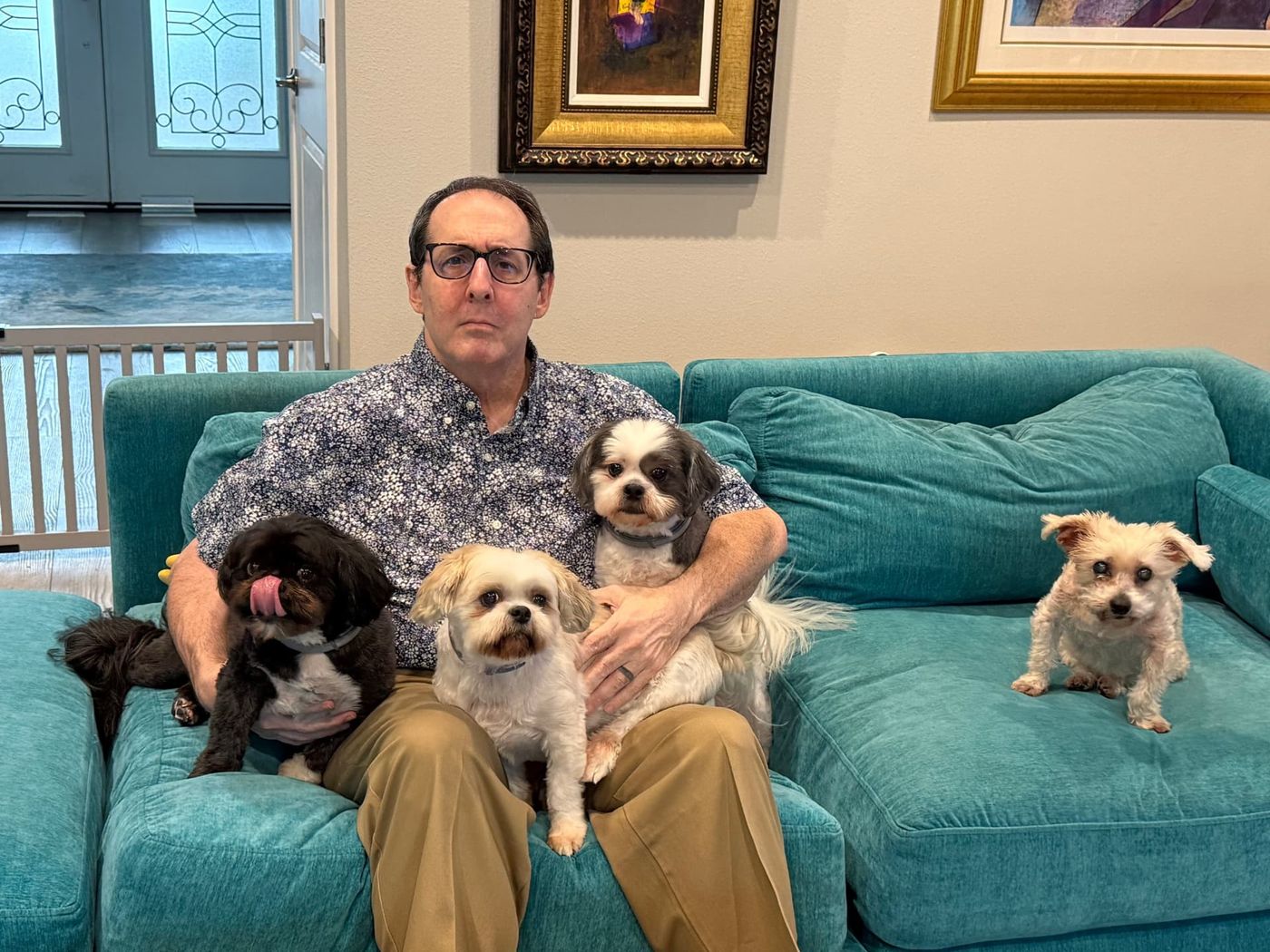
The D-Squad is real. Four dogs, ours, asleep somewhere in the house as I write this. Sully notices what everyone else walks past. Then there’s Baz (Taz is his real-life name, but it had to be changed for the book. Some say witness protection). He wonders out loud, without embarrassment. Dash checks instead of assuming. Phoebe asks the question nobody else thought to ask. I didn’t invent the four moves. I live with them.
For years, when my boys were at their school, I’d bring lathes in and spend multiple days teaching the whole school (about seventy-five kids) to make their own pens. I brought a range of woods to choose from: striped, laminated blanks where the color ran all the way through, English bog oak thousands of years old, and more. Each kid picked their own. They chose their wood, their pen kit, and its style, and each of them got a box to keep it in.
Just because a kid has a learning difference doesn’t mean they aren’t entitled to the best. Or at least the best I could give them. Every single child made a pen. If a kid could run the lathe, they ran it. If they couldn’t, they sanded. If they couldn’t sand, they polished. It didn’t matter where they started. Every child walked away holding something they’d made, in a wood they’d chosen, knowing they made it.
That’s the whole idea behind this book, in miniature: meet a kid where they are, hand them the right tools, treat them like they’re worth it, and let them make something real.
Starting in the 2026-27 school year, I’m donating 2,000 paperbacks to schools, shelters, and homeschooling families across the greater Tampa–Sarasota area—30 to 50 per school: a classroom set, copies for the library, and a few for teachers to send home with kids who need a little extra TLC. Because everybody deserves the right tools.
Not done yet
Here is the most important thing I can tell you about using these tools.
Not succeeding is not the same as failing. Pivoting is not the same as failing. Changing your plan, your timing, or your route is not failing. Sometimes a good idea doesn’t work. Not because it was a bad idea, but because it wasn’t the right idea yet, or the right moment. The only real failure is giving up. So when something doesn’t work, you don’t quit. You adjust, you change course, and you keep going.
That isn’t just a slogan to me. It is exactly what my family is doing right now, today.
As I write this, my wife, our two sons, and I are all fighting recently diagnosed Lyme disease and the chronic co-infections that come with it. The kind of complex illness most people severely underestimate until they are living it. Between the four of us, the person with the fewest has four infections, and the person with the most has nine.
There is no shame in the struggle. We are in treatment, and we are still moving forward. We are still working, still building, and still showing up.
Whatever hits you, and something will, you keep going. You use the tools you have, you find the shape that fits, and you figure out the next move.
That’s why I wrote this book. That’s why the D-Squad exists. And that’s why I’m not done yet.
Phil
Florida
2026